
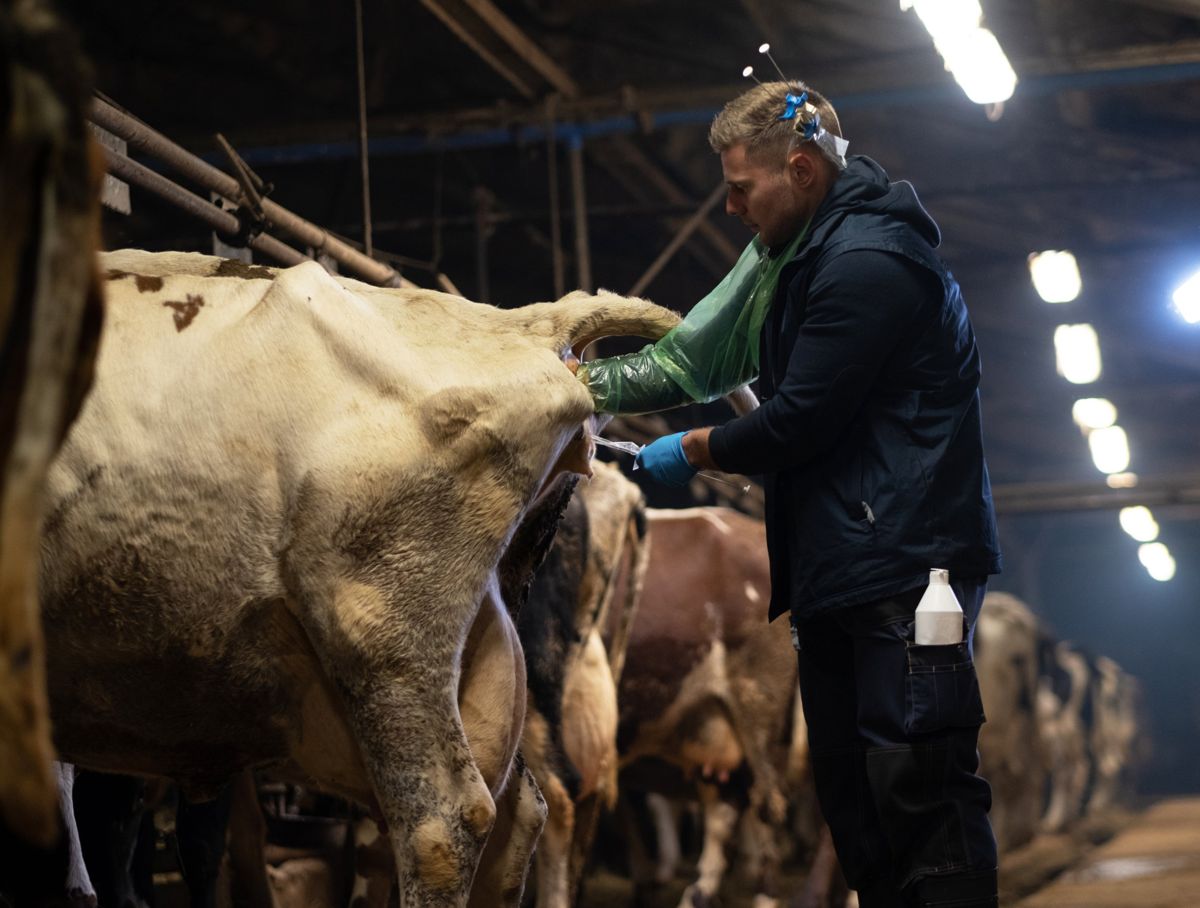
The pregnancy rate measures what percentage of the cows eligible to become pregnant do so in each 21-day cycle. It is obtained by multiplying the service rate by the conception rate. In dairy, a value above 20% is considered good.
What the pregnancy rate is
It is the indicator that best sums up how fast a herd gets pregnant. It answers a specific question: of all the cows that could have become pregnant in the last three weeks, how many did?
It is measured in 21-day periods because that is, on average, the length of the cow's estrous cycle. In each cycle, every eligible cow has one chance.
It should not be confused with the percentage of pregnant cows, which is a snapshot: how many females in the herd are pregnant today. Both figures are useful, but they say different things.
How it is calculated
In a 21-day cycle there are 100 eligible cows: they are past their voluntary waiting period and are not pregnant.
60 are detected in heat and bred: the service rate is 60%.
Of those 60, 24 become pregnant: the conception rate is 40%.
Pregnancy rate: 60% × 40% = 24%. That is the same as dividing 24 pregnant cows by 100 eligible cows.
The classic reference is the 21-day cycle, but the rate can also be calculated by week, by month, or from one vet check to the next. What matters is always comparing equal periods.
A cow is eligible when she has completed the voluntary waiting period, is not pregnant, and is not flagged for culling. Defining that group correctly is half the calculation.
What value to aim for
Common benchmarks for dairy operations, per 21-day cycle:
Many opportunities are being missed.
There is clear room for improvement.
Top herds exceed 25%.
In beef operations with a breeding season, the usual practice is to measure the pregnancy percentage at the end of the season. There the target is usually above 85%.
Why it drops
- Low service rate. This is the most common cause: heats that go unseen or unrecorded.
- Low conception. Timing of service, insemination technique, semen quality, or bull fertility.
- Cows that aren't cycling. Poor body condition score or post-calving problems.
- Heat stress. It affects both heat expression and conception.
- Late diagnoses. An open cow found late loses one or two cycles.
How to improve it
- Split the problem. Look at the service rate and the conception rate separately: the fix is different in each case.
- If service is the weak point, step up heat detection or consider synchronization protocols.
- If conception is the weak point, review service timing, technique, and semen handling.
- Diagnose pregnancy early so you can rebreed without losing cycles.
- Measure it cycle by cycle. The trend over several periods says more than a single number.
Frequently asked questions
Is pregnancy rate the same as conception rate?
No. The conception rate only looks at the cows that were bred. The pregnancy rate looks at all eligible cows, including those that were never bred.
Why is it measured every 21 days?
Because that is the average length of the estrous cycle. Every eligible cow has, in theory, one chance to be bred in each period.
Can I have good conception and a poor pregnancy rate?
Yes. If few heats are detected, few cows get bred, and even if nearly all of them become pregnant, the herd as a whole moves slowly.
What is the repeat breeding rate?
It is the percentage of bred females that need another service in the period because they did not become pregnant. If it rises, conception is worth reviewing.
How many cycles do I need to draw conclusions?
In small herds, a single cycle has few animals and the number swings a lot. It is better to look at the average of several consecutive cycles.
Related terms
This guide is for informational purposes and uses general benchmarks. Each operation's targets and treatments should be set with its veterinarian or advisor.