
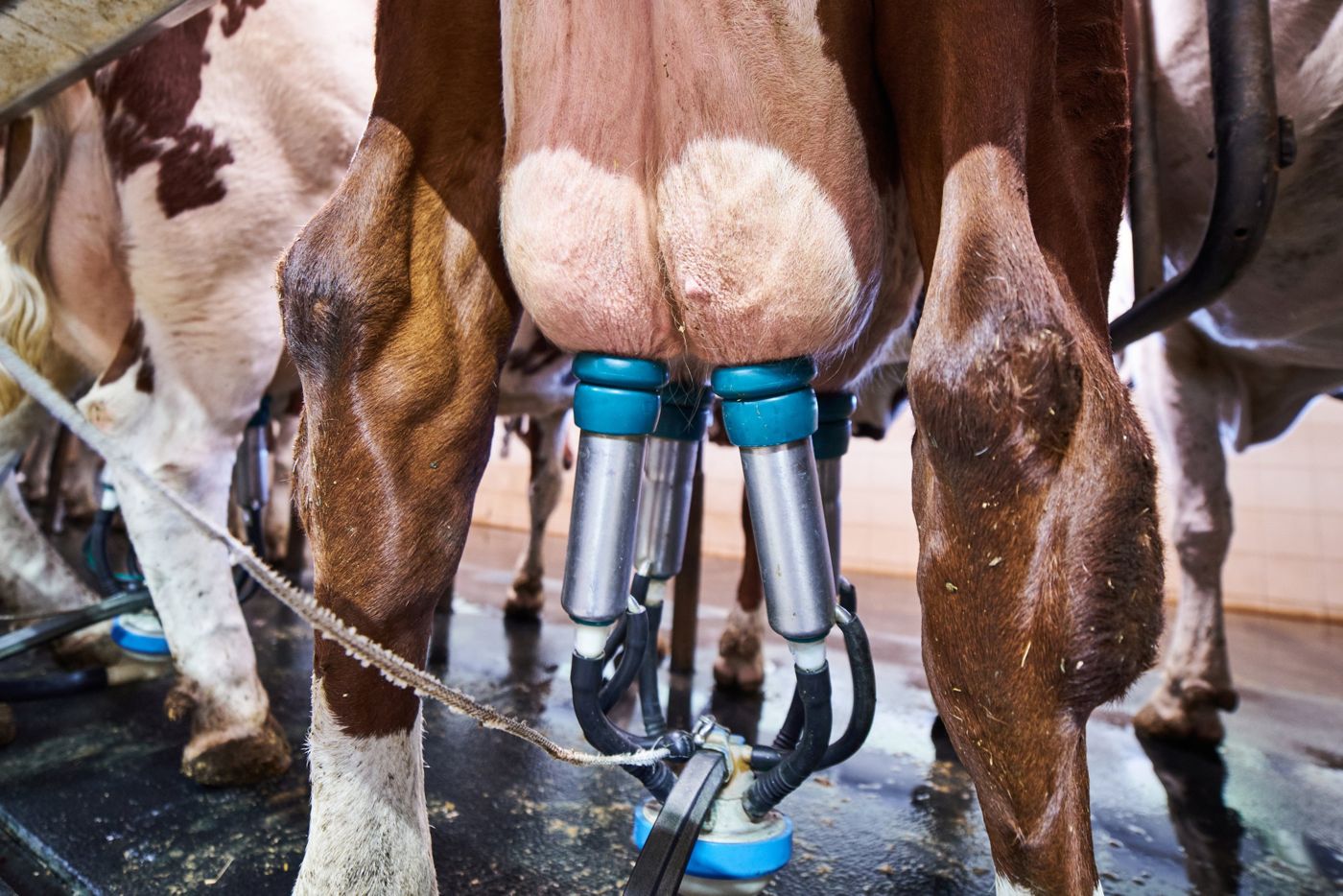
The CMT (California Mastitis Test) detects subclinical mastitis, the kind you can't see with the naked eye. Milk from each quarter is mixed with a reagent and you watch for gel formation: the thicker the mixture, the greater the inflammation. It takes a couple of minutes per cow and is done right at milking.
What mastitis is
It is inflammation of the udder, almost always caused by a bacterial infection. It is one of the costliest diseases in milk production.
- Clinical mastitis: you can see it. There are clots or changes in the milk, and the quarter may be swollen, hot, or painful.
- Subclinical mastitis: you can't see it. The milk and the udder look normal, but the cow produces less and the milk has more somatic cells.
Subclinical mastitis is far more common than clinical mastitis, which is why you need a test to find it.
How to run the CMT, step by step
- Discard the first streams from each quarter.
- Collect milk from each quarter in its own cup on the paddle, about 2 ml per cup.
- Add the same amount of reagent to each cup.
- Swirl in a circular motion for 10 to 15 seconds.
- Read the result right away, in good light.
- Record the result by quarter and rinse the paddle before the next cow.
Always hold the paddle the same way, so you know which quarter each cup belongs to.
How to read the result
The reagent reacts with the somatic cells in the milk. The more cells, the more gel.
The mixture stays liquid. Fewer than 200,000 cells per milliliter.
It thickens or starts to form gel. From 200,000 to 800,000.
Distinct gel that clings to the bottom. More than 800,000.
A common scale has five scores, based on the approximate somatic cell count per milliliter:
- Score 0, negative: fewer than 200,000.
- Score 1, trace: between 200,000 and 400,000.
- Score 2, weak positive: between 400,000 and 800,000.
- Score 3, distinct positive: between 800,000 and 1,500,000.
- Score 4, strong positive: more than 1,500,000.
With a trace, keep an eye on the quarter and repeat the test. From score 2 up, it is considered positive.
When to do it
- Routinely, for example once a month on all milking cows.
- After calving, once the first days of colostrum have passed.
- Before dry-off, to decide how to manage each cow.
- When buying animals, before mixing them with the herd.
- When the bulk tank cell count goes up.
What to do with a positive result
- Record it by cow and by quarter. The history shows whether it is a new or a repeat case.
- Ask your veterinarian about treatment and, where appropriate, a culture to identify the bacteria.
- Milk positive cows last, so you don't spread infection to healthy ones.
- Review the milking routine: hygiene, teat dipping, and equipment condition.
- Evaluate chronic cows. Repeat cases are candidates for culling.
Frequently asked questions
Does the CMT replace somatic cell counting?
It doesn't replace it; it complements it. A lab count gives an exact number; the CMT gives an immediate answer, by quarter and right at milking.
How often should I run the test?
It depends on the herd. A monthly check of the milking cows is a common benchmark, plus key moments such as post-calving and pre-dry-off.
Can I do it myself?
Yes. All you need is the paddle, the reagent, and practice reading the result the same way every time.
Does a positive quarter mean I have to treat?
Not always. The decision to treat, and with what, belongs to the veterinarian, based on the score, the cow's history, and the stage of lactation.
Related terms
This guide is for informational purposes and uses general benchmarks. Each operation's targets and treatments should be set with its veterinarian or advisor.